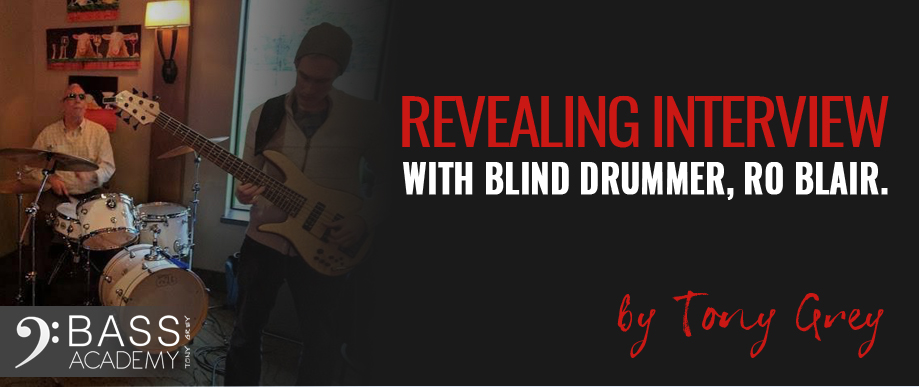
Revealing Interview With Blind Drummer, Ro Blair.
I’ve only played with two blind musicians in my life, but I’ve had the same experience both times, and it’s masterful. It’s not a question of one’s technical ability… it comes down to the connection and awareness, and how one responds and interacts with the music and the other musicians. The ability to completely serve the music because of the body’s natural heightened awareness and gradual sharpening of the other senses.
My ultimate goal in being a musician is to connect with my instrument in a way that allows it to become a part of my voice and an extension of my being. After chatting with a friend and great drummer, Ro Blair, who happens to be one of the two blind musicians I’ve played with in my life, I became fascinated at how he gets through the day seemingly with very little difficulty. He told me he maps out his route in his mind and by memory he’s able to explain things about the room that I’m not even aware of; even things I’ve been staring at every week for the last few months. Ro went on to explain to me the importance of touch and how he knows every bump in his drum kit, he knows what every part of the kit will give him, every angle on every drum.
When I play with Ro and observe how he interacts with me and the music around him, it’s amazing in the sense that he really makes you honest. Everything I play he’s aware of and he reacts either with space or the simplest of acknowledgments to let me know he’s there waiting and talking back.
We can become so distracted visually when we play; thinking about who’s in the room, who’s paying attention, basically focusing on the ego and nonsense. As humans, we often tend to focus on the agenda that meets our personal needs or settles our fears, while failing to see the bigger picture. It’s like the age old saying, “can’t see the forest for the trees.”
One of the most blissful things as a musician is when we find ourselves really in the moment and when we’re in the zone with another musician or musicians, it’s magical. It’s why we play. There is this synergy going on between the musicians and it’s almost like we are blind in the way that everything becomes singular.
I’m striving every day to become more aware of myself and how it impacts my growth, not just as a musician, but as a fellow human being. I study in a way that brings me closer to my truth and my own voice as a musician and it requires a lot of love and dedication, but it’s well worth it.
John McLaughlin always told me. “Take care of music and music will take care of you”. I want to serve music in a better way and not let the ego driven distractions fool me or pull me away from the freedom I crave.
So, let’s get into the interview…
TONY: Hi Ro, how’s it going? Thanks for helping us all out here. I was really intrigued after one of our conversations, because you left me feeling inspired and aware that there’s so much more than what meets the eye when it comes to learning and expressing ourselves through music. Can you tell us a little bit about yourself and where you’re from, when did you decide you wanted to be a musician and how did it all start for you?
RO: Sticks-up Tony! Life is grand, thanks for asking. I’m a native of Erie, Pennsylvania, born the youngest of three boys to extremely loving and supportive parents (God rest their departed souls).
When did it all start, and when did I decide I wanted to be a musician? That decision was never really an option for me. I was born with music playing in the house. My folks, non-musicians, both played the radio, TV and occasionally the record player. Subsequently, I grew up from infancy listening to polkas in the kitchen and learning to dance with Mom every Sunday while dinner was cooking, drew a strong affinity to the emotional component of country music early on as Dad was a big fan of the genre, and recall first paying close musical attention to some of my older brothers’ records by artists like Paul and Paula, Brenda Lee, Elvis and the like from that late 50s / early 60s era.
Though my Mom signed me up for drum lessons when I was 7 (more on that to come), bought my first full 3-piece Slingerland drum kit for me for my 8th birthday and drove me to and paid for every single weekly lesson until I was 12, the edict of the parents was made very clear from day-1: “Music is something nice to fall back on, but you can’t play music for a living. You are going to make the honor roll through school, get a college education and work for the Government so we know you’ll be alright when we’re dead and gone!”. My retort as a kid was always “I don’t know what I want to be when I grow up, but I want to do something with my hands.”.
Well, I was definitely not an honor roll student through high school; eventually however, did obtain dual degrees in business administration and human psychology from Penn State University; have worked in a plethora of jobs and fields throughout my professional lifetime to include, but not limited to my first summer job working in the hand mitts at a carwash when I was just 14, as accompanist in the music education / therapy department in a birth-to-death facility for persons with developmental disabilities, as Project Manager for an international head hunter, in my own private practice as an Applied Canine Behavior Consultant, and, in public sector vocational rehabilitation as an Assistive Technology Consultant.
I retired last year, and at 63, I still don’t know what I want to be when I grow up. Through all this, I have managed to play music professionally for most of the past 53 years; everywhere from solo performer to weekend club bands to 6 night a week lounge playing on the road. In short, I guess you could say that my life has been richly infused with music since day-one with caveats.
TONY: Did you always play drums or did you start with another instrument first?
RO: Interesting story there Tony. I mentioned that I was drawn to the emotional component of country music early on. Even as a 5 – 6 year old listener, I learned that it made me cry and smile at the same time, and I loved the sensation of feeling those inner-depths from within myself; still do. Of course, now, I know that it was the infinite tonal range of the pedal steel guitar that touched my soul, but as a small kid, I equated that sound to that of what I only knew then as the Hawaiian guitar. Come hell or high water, I wanted to learn to play that Hawaiian guitar.
Mom took me to a local music studio when I was 7 only to learn that there was no one in town who taught the instrument. The owner / music instructor there pointed to an accordion hanging about 8 feet up on a wall and asked me to count the buttons on it while he talked to my Mom about options. Hell, I couldn’t even see the wall he pointed to let alone the accordion hanging there well out of my reach. After a 10 minute consultation with Mom, it was decided that I would take up the drums. Thus it began.
As for playing any other instruments, that came a few years later. My next oldest brother, also born blind, started piano instruction when he was 7, then, switched to guitar at age 12.
We formed our first band with another classmate who played guitar when I was 9 playing for school functions and entertaining at senior citizen homes until I was 12 and left home to attend boarding school.
I attended the Western Pennsylvania School for Blind Children in Pittsburgh PA from 7th through 11th grades where we had very strong music programs along with excellent academics. From my first year there, I sang in junior high chorus and our senior choir, played drums in our school jazz ensemble, and had access to a myriad of stringed, brass and woodwind instruments and keyboards to experiment with in our practice studios which were open and available to us throughout evenings and weekends.
Believe me when I tell you Tony, I took advantage of getting my hands on as many of those instruments as I could and playing them with others every chance I got,. As I reached dating age in a residential Co-Ed school however, I followed in my brother’s footsteps learning to play guitar by ear with definite ulterior motives. It’s much easier to woo a date with a sweet guitar ballad on a porch swing than with a big old drum solo in the basement!
I then came back home to complete my senior year in our local public school system all the while playing weekend bar gigs and frat parties in bands with my older brother.
TONY: How does being blind affect your experience of playing music? In what ways has it helped you to become a better musician?
RO: I’m not sure that being blind necessarily equates directly with being a “better musician” in that, to me at least, seems to imply a talent hierarchy of sorts. I like to think of myself as a conscientious musician, and that my blindness has definitely been an asset to me on my path of musical development. Let me try to hone in on a couple key topics in this respect.
Firstly – let me dispel the old myth that “People who are blind have better hearing.”. Our hearing is simply more developed than folks with sight. When you are born with full faculty of all of your 5 senses, sight is the most powerful with 75% of your environmental sensory intake being absorbed through vision. Doing the rough math, this leaves an average 6.25% each for development of hearing, smell, touch and taste.
In that blindness has been my normal since birth, I have grown up distributing perceptions of my world through a relatively equal development of my remaining senses. I believe that this has allowed me to become more attuned to some of the minutiae of playing my own instrument and contributing to the gestalt efforts of other musicians I’m performing with. So it’s not that others’ senses are lacking, we’re all on an even part there. Let go of some of your visual cues in life and you too can develop your other senses more evenly.
Commitment has been another key factor to my over-all experience. While my peers had access to group activities requiring sight like organized sports, driving Etc. to occupy their time while growing up, I remained primarily committed to my instrument, my drums. Through this, I have attracted social contacts and formed circles with likeminded musicians over the years which has allowed me to concentrate my attention to my trade perhaps more than some who have multi-tasked through life if you will.
I guess my final thought on this particular subject boils down to the word systems. When one grows learning through “normal” visual processing, there’s an immense amount of social and bio-mechanical information that can be assimilated into patterned behavior in a direct route from the eyes to other body parts through modeling what others do. There’s also a lot of information here which one does not need to instantly recall.
Throw your keys on the table when entering the house after work, you can quickly retrieve them visually the next morning without a second thought. Toss the gas bill into a pile of other papers on the desk, you can quickly find it 2 weeks later when it’s time to pay it. Without that all-encompassing vision, one must develop logical, lifetime organizational systems early on to accomplish simple and complex tasks in a timely fashion. How does this relate to my music you may ask? It is the scaffolding of those logical systems from a very early age which have allowed me to take a truly hands-on approach to every aspect of my playing.
Music itself is based on mathematical systems. The mechanics and physics of any instrument are rooted in logical systems. When you learn without looking, I think that you are forced to develop a near-field spatial orientation to your instrument, a physical intimacy, that allows you to embrace how it feels, sounds, plays, even smells along with how to play it unencumbered by the potential for visual distraction. I think this leads to a greater oneness with your instrument.
TONY: How do you feel when you’re playing with other musicians; how do you perceive their energy and how does it impact the music for you?
RO: And on one of those 7 days, I know in my heart that God said “let there be music”, and a universal, sublingual communication was born. To me, music is feeling. Music evokes a range of feelings. As it did when I was 5 and listening to those Hawaiian guitar players on the country stations, music drives a range of emotions for me to this day when I’m playing.
Throughout my career, I have played with cats with lesser, equal and much more expansive skillsets than I. Yet, in my opinion, we’re all equals on the bandstand or in the rehearsal space. Growing up without vision, listening has always been one of my strong suits; whether that’s listening to what a person is saying to me, or what others are playing with me. I read recently that “music is like a conversation”, and have always considered respect for my bandmates’ words (notes) to be as important as adding my own well considered input to the conversation of the tune. Respectful listening and reciprocation leads to trust among band members and can only add to the depth of the music being played.
As a side note: You really learn the emotional power of music when you’re playing in a class of children with autism and a 12-year-old boy whose never spoken a word in his life suddenly, and without prompting, starts singing out loud along with his verbal classmates. Yes, music is feeling!
TONY: Do you see or feel color when you play and listen to music?
RO: That’s an interesting question. I was born with some extremely limited visual acuity as a child that allowed me to experience primary colors; red, yellow, black, white, blue and some others but they were never a high priority on my visual repertoire, especially since losing all residual vision to total blindness in 1999. I tend to channel my playing energies through my hearing to my tactile senses and let those dominate my mind’s eye. Again, listening is paramount on the bandstand; listening to the over-all ebb and flow of the dynamics of the ongoing musical conversation, listening to each individual musician as they add their own thoughts and feelings to the story being presented, listening to my own playing contributions to ensure that they hold the timing and timbre of the song, and listening to the acoustic balance in the room to make sure that our conversation is a pleasantry for patrons.
TONY: They say music never lies; what’s your perspective on this?
RO: Music is childlike. Children don’t lie; adults learn to lie. Eric Dolphy once said “When you hear music, after it’s over, it’s gone, in the air. You can never capture it again.”. A lie must be protected and perpetuated to cloak the real intent of its perpetrator. Music cannot lie.
TONY: Can you give us some insight on getting to know our instrument and why it’s important?
RO: I think there is a difference between owning an instrument and learning to play music on it versus knowing your instrument as an extension of your being and being able to excel in your playing with it. I taught computer skills and provided desktop support to my customers for 17 years before I retired. Here, I identified 2 basic groups of consumers. One group, the ends-oriented people, did not care to learn anything about the logic of the operating system and the technical componentry of their hardware, they just wanted me to teach them how to sit down and make it meet their immediate needs through its installed applications. The other, those who appreciated learning machine logical systems as a means to an end, exhibited a childlike curiosity and took an in-depth, hands-on approach to interacting with their hardware and software. Would you care to hazard a guess as to which group ultimately excelled in their abilities and required much less technical support throughout their training?
Music is universal. We are all connected in some way to each other and to those material things that make up our physical world. Your instrument, if recognized as a living, breathing entity with an individual soul of its own, can become a connected, expressive extension of your own unique personality. Taking the time to truly know your instrument as an integral purveyor of your own character, coupled with careful and continuous study of the techniques in music that are intended to ever expand your combined musical vocabulary will catalyze your vision of excellence into reality.
TONY: How has music helped you in your life? What other areas of life has it bled into and impacted?
RO: I would have to say that my love for and commitment to music has positively expanded my social circles, heightened my EQ, deepened my appreciation for the ethereal, expanded my thirst for knowledge and allowed me to bond with some truly magnificent, talented, caring and giving beings throughout my lifetime, and, for that I am deeply flattered.
John McLaughlin is absolutely spot on in telling you, “Take care of music and music will take care of you”.
TONY: Thank you so much for your time Ro, your insight provides incredible perspective for us all.
RO: And thank you Tony for your kind words and this opportunity to touch your readers with some of my thoughts and personal anecdotes here in your forum. Bless you my brother, and may your endless musical journey and that of your readers soar to infinity.